Homework Planner Amazon KDP Interior: A Strategic Asset for Purpose-Driven Creators
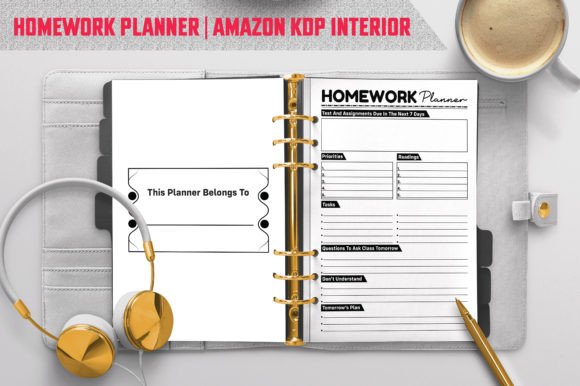
At first glance, Homework Planner Amazon KDP Interior appears to be a simple printable planner layout—8.5″ x 11″ and 6″ x 9″ options, 120 pages, print-ready PDF and EPS files, 300 PPI with bleed. But its real value isn’t in the pixels or page count. It’s in how deliberately you choose to deploy it—as part of a broader system for clarity, consistency, and customer-aligned delivery.
Why This Isn’t Just Another Planner Template
This isn’t designed for passive consumption. The Homework Planner Amazon KDP Interior is built for intentionality: clean lines, minimal visual noise, and functional white space that invites structure—not clutter. That matters because every element you include (or omit) in your KDP interior shapes how readers experience your brand before they read a single word. A rushed or generic interior signals low investment. A thoughtful one—like this—builds quiet credibility. It says: I understand what learners, students, or self-directed users actually need to plan, reflect, and follow through.
That alignment becomes strategic when you consider who’s using your planner: educators building supplemental tools, tutors packaging study systems, curriculum designers scaling resources, or even corporate trainers developing onboarding kits. Each of those use cases demands different pacing, scaffolding, and cognitive load management—and the Homework Planner Amazon KDP Interior gives you the flexibility to embed those distinctions without redesigning from scratch.
How to Use It With Purpose—Not Just Convenience
Start by asking: What outcome do I want this planner to support? Not “sell more copies,” but rather: “Help high schoolers reduce task paralysis,” or “Enable adult learners to track micro-progress across 12 weeks of skill-building.” Your answer determines how you adapt the interior—not just add text, but shape rhythm.
- For habit formation: Use the 120-page count to map weekly reflection prompts across a full semester—each week ending with a 3-line review (“What worked? What stalled? What shifts next?”). That builds metacognition, not just compliance.
- For classroom integration: Reserve the first 10 pages for teacher-facing notes—lesson alignment codes, differentiation tips, or editable rubric anchors—so the same interior serves both student and instructor.
- For digital-first creators: Layer in QR codes (using the EPS file for precise vector placement) that link to video walkthroughs, downloadable checklists, or community forums—turning static pages into entry points for deeper engagement.
The key is restraint. You’re not filling space—you’re curating attention. That’s why the clean, minimal design isn’t aesthetic preference; it’s functional discipline. Every extra icon, border, or decorative flourish competes with the user’s focus. The Homework Planner Amazon KDP Interior removes that friction by default—so your content, voice, and structure carry the weight.
Timing Matters More Than Tools
Don’t wait until launch day to decide how your interior supports goals. Integrate it early in your planning cycle—ideally alongside your title, subtitle, and cover concept. Ask: Does the interior’s pacing match the promise of the cover? If your title promises “stress-free exam prep,” does the interior include spaced repetition trackers and anxiety-calming reflection prompts—or just blank calendars?
Also consider timing in production. Because this interior ships as a ZIP folder containing both PDF (for KDP upload) and EPS (for scalable edits), you gain flexibility at two critical stages: pre-upload refinement (e.g., adjusting margins for perfect binding) and post-launch iteration (e.g., swapping out a lesson module based on buyer feedback). That dual-format readiness means you’re not locked into one version—you’re positioned to evolve.
Risks of Using It Without Context
A well-designed interior can’t compensate for misaligned positioning. If you publish a “Homework Planner” targeting college STEM majors but fill the Homework Planner Amazon KDP Interior with elementary-style illustrations and vague “do your best!” affirmations, the disconnect will register instantly—especially among savvy, time-constrained buyers. They’ll sense the mismatch between expectation and execution, and bounce.
Similarly, overloading the interior with dense instructions, excessive branding, or untested productivity frameworks risks overwhelming users instead of enabling them. Remember: the goal isn’t to showcase your knowledge—it’s to remove barriers between the user and their own progress. If a page requires more than 5 seconds to parse, it’s working against you.
Another subtle risk: treating the interior as disposable. Once uploaded to KDP, revisions require new ISBNs, updated listings, and potential customer confusion. So test thoroughly—print a physical proof, simulate real usage (e.g., “Can someone complete Week 3’s assignment tracker without rereading directions?”), and validate assumptions with actual users before finalizing.
Long-Term Value Lies in Repurposing, Not Repeating
The true ROI of the Homework Planner Amazon KDP Interior emerges when you treat it as a modular foundation—not a one-off asset. For example:
- You launch a core homework planner targeting middle schoolers.
- Based on reviews, you notice demand for a “teacher edition” with grading columns and parent communication logs. You reuse the same interior structure—same page count, same bleed specs—but swap in educator-specific fields using the EPS layers.
- Later, you adapt the layout into a “Study Skills Journal” for adult learners—keeping the clean grid and spacing, but replacing due-date trackers with confidence-rating scales and resource-mapping grids.
Each version shares DNA but serves distinct outcomes. That’s efficient scalability—not copy-paste duplication. And because the files are print-ready at 300 PPI with bleed, you avoid costly reformatting delays when expanding into paperback, hardcover, or even bulk-printed workshop kits.
Practical Next Steps—Before You Upload
If you’re preparing to use the Homework Planner Amazon KDP Interior, run through this short checklist:
- Verify alignment: Does every section—from weekly spreads to end-of-month reviews—directly serve your stated user goal? Cut anything that doesn’t.
- Test readability at scale: Zoom out to 25% in your PDF viewer. Can you still distinguish headings, input areas, and instructions? If not, simplify typography or increase spacing.
- Confirm KDP specs: Double-check that your 8.5″ x 11″ or 6″ x 9″ PDF matches KDP’s current margin and bleed requirements—not just the file size, but gutter allowances and safe zones.
- Plan for version control: Name your files clearly (e.g., “HWPlanner_Interior_v2_TeacherEd.pdf”) and keep the original EPS as your master source. Future edits will be faster and more precise.
Finally, remember: the interior is never the product—it’s the vessel. Your insight, your understanding of real workflow pain points, and your commitment to usability are what turn a well-formatted PDF into something people return to, recommend, and build habits around. The Homework Planner Amazon KDP Interior gives you a strong, reliable vessel. What you choose to carry in it—that’s where strategy becomes impact.